
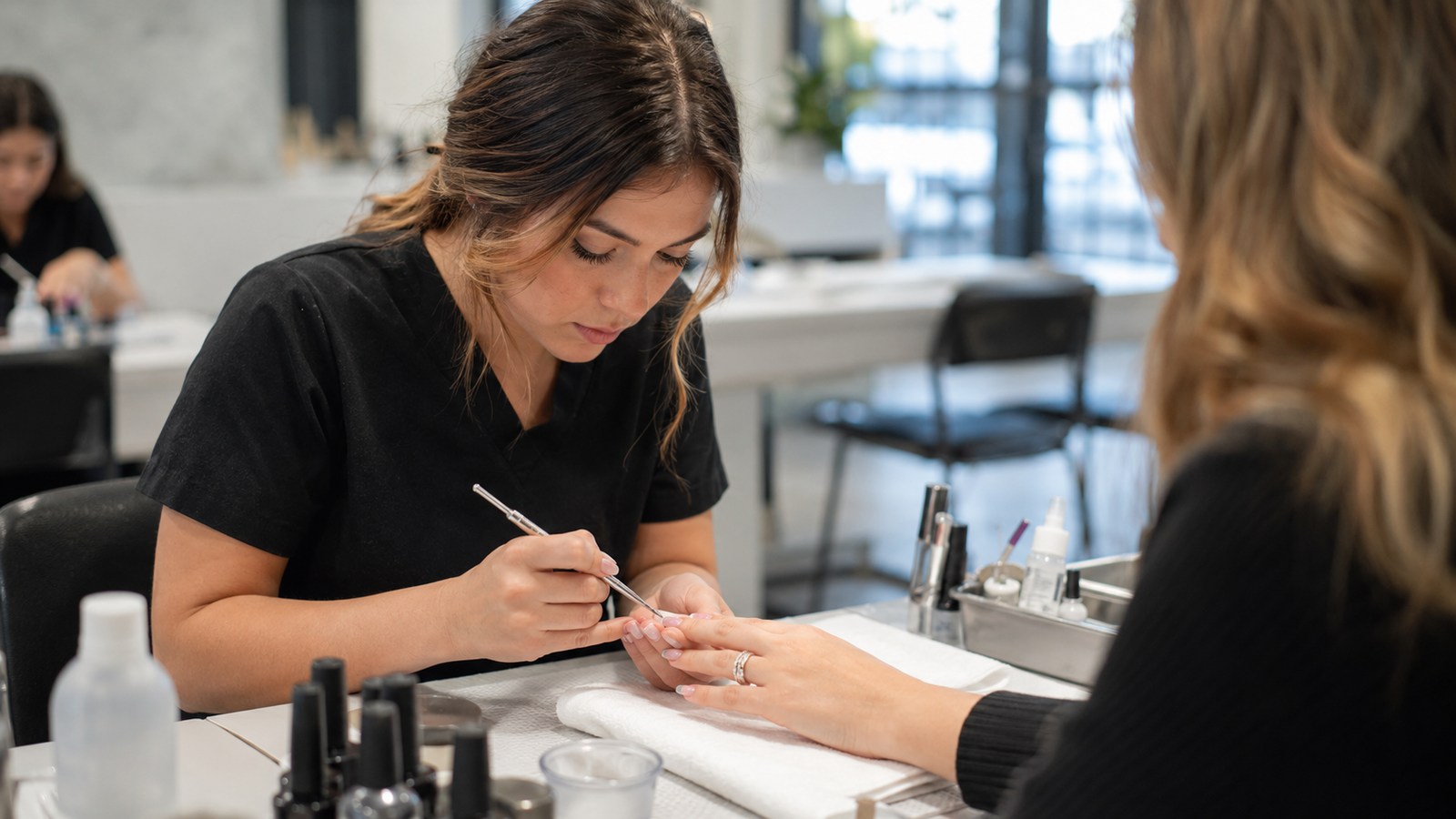
manicurist salary guide
The Manicurist Salary Guide That Skips the Guesswork
This manicurist salary guide explains what actually drives income in Texas. Booth rental versus commission. Add-on services. Repeat clients. Not just one flat number.
Quick Answer
- Income depends heavily on pay structure — booth rental, commission, and salary all pay differently.
- Add-on services like gel, dip powder, and nail art can meaningfully boost income beyond a base manicure price.
- Repeat clientele matters more than the base service price alone.
- For current wage data, check the Texas Workforce Commission and U.S. Bureau of Labor Statistics.
- Speed and consistency both affect how many clients you can serve in a day.
Why Pay Structure Changes Everything
One number misses the real story. How you're set up to work shapes income more than raw skill alone.
Booth renters keep what they earn. But they cover their own rent and supplies. Commission techs earn a cut of each service. Often with steadier hours, but a smaller cut per client. Salaried roles are less common. They offer stable pay, but a capped upside.
Getting licensed is faster than most other cosmetology paths. 600 hours at a TDLR-licensed school, roughly 4–6 months full-time — one of the shorter training windows in the field, which shapes how quickly a new tech can start earning.
For real, current wage data in Texas, check the Texas Workforce Commission directly. Skip the generic figure you'll find scattered online.
Booth rental, commission, and salary pay very differently, even for identical skills. Compare within the same structure, not across all three.

What Actually Moves the Number
A few things matter more than people expect. Beyond the base pay structure itself.
Add-on services push income up fast. A basic manicure priced alone earns less than one paired with gel, dip powder, or nail art that clients are often happy to book.
Speed matters too. A tech who works efficiently, without cutting corners, can serve more clients in a day. That adds up over a full week.
Repeat clientele matters most of all. A manicurist with a full, loyal book earns very differently than someone building a client list from scratch, even with identical technique.
Location plays a role here too. A shop in a busy shopping district often supports a higher per-service price than a similar setup in a quieter area, independent of the technician's actual skill level.
- Pay structure: booth rental, commission, or salary
- Add-on services beyond the base manicure
- Speed and efficiency during a shift
- Clientele size and repeat business
What Grows Your Income Over Time
Any manicurist salary guide worth reading should cover growth, not just a starting point. A few things tend to push income up over a career. No matter where you began.
Specialization often helps. Focus on nail art, structured gel work, or a specific technique. That can support higher pricing than basic services, once you've built a name for it.
CE plays a role too, beyond just meeting the TDLR requirement. Learning current techniques keeps your service menu aligned with what clients are actively seeking out.
Consistency matters more than any single big move. Reliable hours, steady quality, and repeat clients add up over years. More than any one dramatic change ever will.
A steady referral base, built through consistent quality rather than promotions, tends to hold up better over time than any single marketing push.
Frequently Asked Questions
Why doesn't this manicurist salary guide give one specific number?
Income varies too much by pay structure, add-ons, and clientele to represent fairly with one figure. Booth rental, commission, and salary positions pay very differently even for the same skill level.
Where can I find accurate manicurist salary data for Texas?
Check the Texas Workforce Commission and the U.S. Bureau of Labor Statistics directly. Both publish current wage data that beats any single estimate from a third-party source.
Do add-on services actually increase manicurist income?
Yes. Add-ons like gel polish, dip powder, and nail art paired with a base manicure can meaningfully increase what a single appointment earns.
What matters most for growing manicurist income?
Repeat clientele, add-on services, speed and efficiency, specialization, and consistency over time tend to matter more than any single dramatic change or move.
Does specialization actually help manicurist income?
Often, yes. Focusing on nail art or a specific technique can support premium pricing once you've built a reputation in that specialty.